Best Prepaid Cards for Kids and Card-Based Learning
Prepaid cards for kids are popular tools for teaching money concepts, responsibility, and decision-making through playful, safe experiences. This guide highlights five suitable products that blend pretend play with financial literacy, classroom fun, and thoughtful gifting. Each option offers engaging features designed for children and families, while helping caregivers manage learning moments with concrete, age-appropriate activities.
Summary of selected products:
| Product | Brand | Type | Key Benefit |
|---|---|---|---|
| Casdon Pretend Play Cards Set | Casdon | Imaginative play cards | Realistic scenario cards to teach basic finance concepts |
| Zwttey Daily Routines Flash Cards | Richardy | Educational flash cards | Routine-based learning for early learners |
| Animal Fun Fact Cards with Bookmarks | T MARIE | Greeting cards with bookmarks | Engaging notes and interactive bookmarks for reading prompts |
| 24 Funny Animal Joke Notecards | T MARIE | Humorous notecards | Wholesome humor paired with unique designs |
| Decorably Thinking of You Cards | Decorably | Assorted thinking-of-you cards | Varied animal designs with printed messages for kids |
Across these options, you’ll find a mix of pretend-play tools, educational flash cards, and kid-friendly greeting cards that encourage literacy, numeracy, and social-emotional learning in a playful context.
Casdon Pretend Play Cards Set

The Casdon Pretend Play Cards Set delivers authentic-feeling cards designed for imaginative play. Each card mimics real-world items to help children role-play scenarios like shopping or banking, fostering curiosity about money and payment concepts in a safe, guided way. The set supports early exposure to financial literacy by integrating basic ideas of exchange, value, and decision-making within everyday pretend play. The cards’ realistic design encourages storytelling and social interaction during playtime, making it suitable for both individual and group activities.
Educational angles include building recognition of common transaction scenarios and introducing vocabulary related to money and gifting. Parents and educators can use these cards to prompt conversations about budget-aware choices, saving, and the idea that money is exchanged for goods and services. The cards are visually engaging, helping children connect numbers, images, and practical outcomes in a memorable, hands-on manner.
Zwttey 45PCS Daily Routines Flash Cards
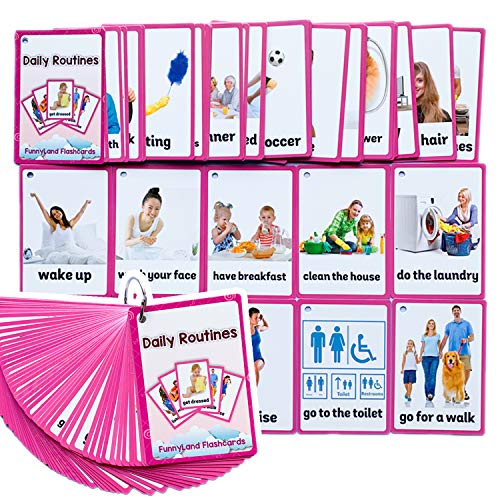
This 45-piece set is designed to support daily routine learning for preschool and early elementary students. The compact, portable format makes it easy to carry and use at home, in classrooms, or on the go. Each card features a clear image and a corresponding word to reinforce language development and reading readiness, helping kids internalize everyday activities. The deck is suitable for games, memory activities, and routine-building exercises that can accompany money-focused lessons by pairing with pretend play or classroom role-play about purchasing items or planning a day’s activities.
Educators can use these cards to structure short, engaging activities that improve attention, memory, and sequencing. Parents may pair the cards with simple reward concepts, encouraging children to finish tasks in exchange for small pretend purchases or privileges in a play shop. The deck’s compact size and durable design are practical for daily use in busy homes or schools.
Animal Fun Fact Cards With Bookmarks

These 20 animal-themed greeting cards come with pop-out bookmarks, offering a playful twist on traditional notes. Each card shares an educational fact about the featured animal, blending literacy with science. The pop-out bookmarks provide a tangible takeaway that encourages continued reading and interaction beyond the card itself. The set includes color-coordinated envelopes and a storage box, supporting organized sharing and easy gifting. While primarily a communication tool, the combination of facts, design variety, and bookmark functionality makes it a versatile way to spark curiosity and storytelling in kids.
From a learning perspective, the cards invite conversations about animals, habitats, and simple scientific facts. For families, they serve as a charming, compact gift or classroom supply that promotes writing, empathy, and storytelling. The durability of the cards and the added bookmark feature foster repeated use, which can reinforce memory and comprehension through repetition and reference during reading time.
24 Funny Animal Joke Notecards

This bundle offers 24 unique, non-repeating notecards featuring playful animal illustrations and clean jokes. The front of each card delivers a pun or light humor, while the inside reveals a punchline or message. The humor is appropriate for a wide age range, making these cards suitable for kids, students, teachers, and families. The bulk format ensures there are plenty of options for sending notes, making this a practical gifting choice that encourages handwritten communication and social connection in classrooms, homes, or clubs.
In terms of literacy and social skills, the jokes promote verbal expression and listening. The bright designs support recognition and vocabulary growth, while the inside messages can be used as writing prompts or discussion starters. The assortment style allows for themed activities, such as “letter-writing week” or “random acts of kindness” card exchanges among peers and family members.
Decorably 24 Pack Thinking of You Cards

The Decorably thinking-of-you set offers 24 animal-themed cards with envelopes and printed inner messages. Each card carries a friendly sentiment designed to brighten someone’s day, making them ideal for kids who want to practice writing notes and sending kind messages to friends, teachers, or family. The included envelopes and stickers support a fun, personalized finish, while the printed messages provide ready-made inspiration for younger children who are still learning how to express themselves in writing.
From a broader perspective, these cards reinforce social-emotional learning by encouraging generosity, thoughtfulness, and communication. They also present a low-pressure way to practice handwriting, spelling, and sentence construction. For classrooms or after-school activities, the assortment offers a reliable stock of sendable notes that can be paired with small rewards or classroom recognition programs to reinforce positive behaviors and relationships among peers.
Buying Guide: Key Purchase Considerations
- Age appropriateness: Select card sets and flash cards that match the child’s developmental level and reading ability. Look for visuals and vocabulary aligned to early learning milestones.
- Educational angle: Prefer products that blend literacy, numeracy, and financial concepts through pretend play or structured activities. Cards that prompt discussions about money, budgeting, or responsible gifting can support early financial literacy.
- Durability and materials: Cards should be durable for frequent handling by young kids. Look for sturdy cardstock, coated surfaces, and packaging that reduces wear during travel or classroom use.
- Reusability: Sets with bookmarks, envelopes, or storage boxes enhance reuse and organization. Sturdy storage helps keep materials in good condition for ongoing learning.
- Engagement and design: Bright colors, friendly animal illustrations, and clear icons boost engagement and help kids recall words and concepts, improving retention over time.
- Portability: Compact flash cards and lightweight sets support learning on the go, in cars, or during travel, enabling frequent short learning sessions.
- Cost per use: Consider the total number of activities a set supports and whether it includes multiple learning modalities (reading, writing, pretend play) to maximize value.
- Teacher and caregiver resources: Some sets come with suggested activities, discussion prompts, or classroom ideas; these can be valuable for planning lessons or family tasks.
- Gifting and sharing: If the goal is to encourage note-writing or classroom participation, a mixed assortment of cards can offer variety for different recipients and occasions.
Overall, the selection emphasizes hands-on, safe experiences that translate to practical learning. When choosing, consider how each product can support a balanced approach: playful pretend money concepts, literacy-building activities, and social-emotional growth through thoughtful communication.